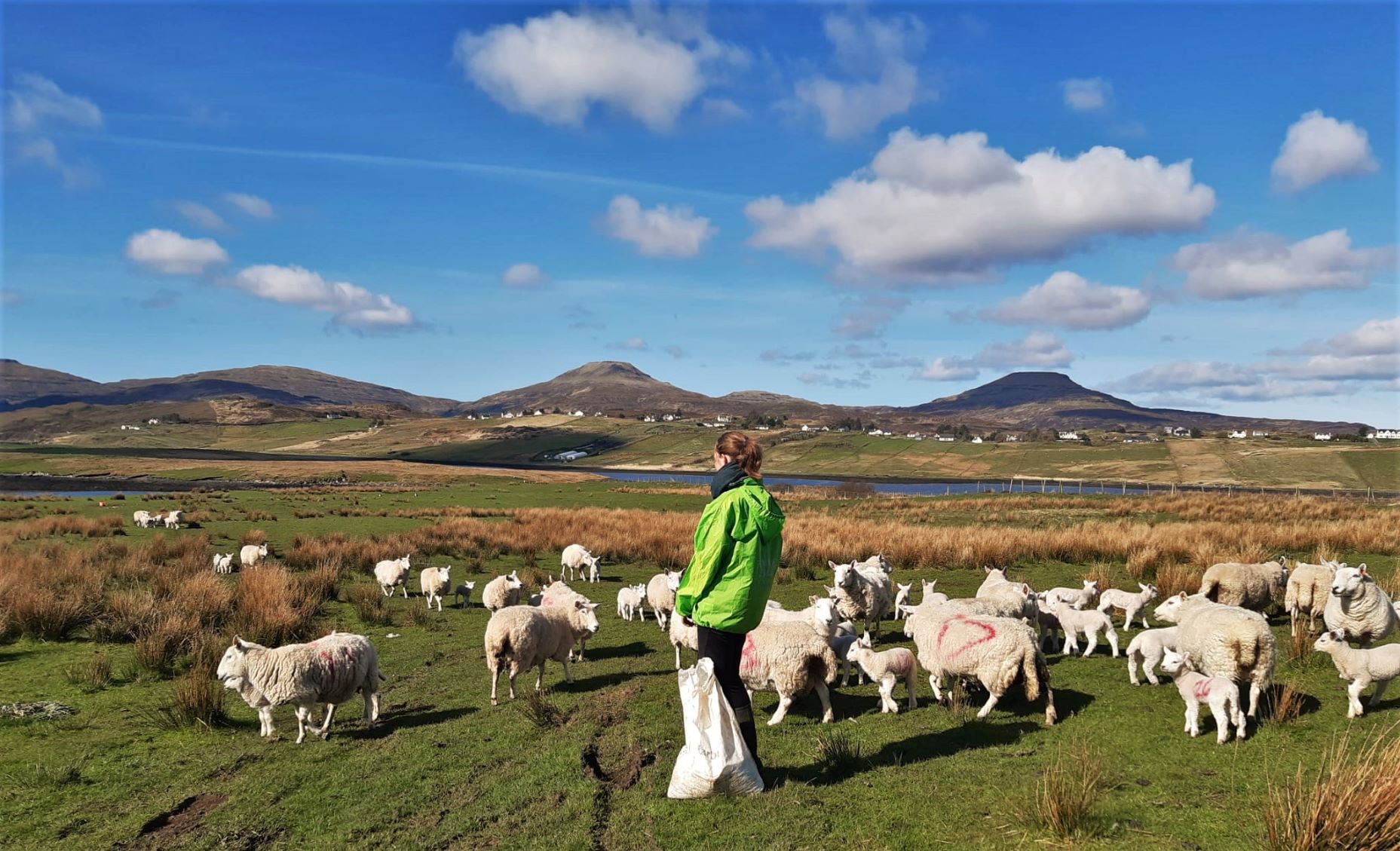
Six weeks of farm work on two crofts in Scotland, one on the Isle of Skye and one on Great Bernera in the Outer Hebrides. Here you can read about what it taught me about language and the rhythm of a place.
When I went to Scotland, I knew that the Scottish accent needs some time to get used to but I was not prepared for how much farming depends on the speed with which I needed to understand the instructions. So imagine my surprise when I was standing in a field of sheep, holding a small metal tool and was being told by someone with a thick Scottish accent to Gie the wee yin a dose an' pop her back ower the gate . While this is still English, I was struggling to understand the meaning of it. Over the course of my time in Scotland, not only learned I about organic farming but also that the language of a place embodies the spirit of the place and people. I had come to two small farms, one on the Isle of Skye, one on Great Bernera in the Outer Hebrides to work as a volunteer on organic farms in exchange for room and board. I had imagined something like weeding, occasional sheep herding and building little shelters. What I got instead was much more interesting and definitely less monotonous.
Wrestling sheep, cutting peat
On Allie's farm on Skye, my mornings began before seven. We loaded sacks of feed onto a quad-bike trailer and drove out to the various flocks scattered across the hillside. They had hill sheep on the upper pastures, mothers with young lambs in the lower fields and cattle and one horse in their own enclosure further down. Each group had its own ration, its own routine and of course also its own personalities. After two days of being shown how to care for them, I was sent out alone with the quad and a list.Since there was quite a lot of sheep that needed to be fed and I was still trying to understand how all the pastures were connected, I promptly forgot to feed one of the flocks. Fortunately, the bags of food were numbered and once I realised that I had one bag too much, I remembered the flock of sheep on the other side of the hill. I arrived there quite a while after their usual feeding time which of course they had to tell me with indignant bleating. Every day, I got introduced to a new task that I had to take up in my daily routine.
Variety of farm work
First, it was digging and replanting a vegetable bed that the previous volunteer had charmingly weeded by simply turning the grass upside down which meant I had to excavate every clump and shake out the soil twenty times over. The next day, we rounded up the hill sheep into a double-decker trailer for transfer to a fresher pasture which involved separating the flock into two roughly equal halves and pushing one group up a ramp while holding the rest back. That might sound like a relatively easy task but in practice it usually turned into chaos. I also learned to cut peat which a centuries-old craft on Skye with its own tools, vocabulary and small rivalries between neighbours over whose peat cutting row was straightest. I learned to wrestle a sheep which is exactly what it sounds like. You grip the wool above the shoulder blades and clamp the animal between your knees to walk it from one place to another, while it tries with all the energy in its surprisingly strong body to be elsewhere.
Lessons from the farm
What impressed me most on Skye was seeing the rhythm of life and death with none of the distance most of us are used to. When a lamb died on the pasture, the farmer skinned it and tied the pelt to an orphan lamb so its scent would convince a grieving ewe to accept the substitute. I watched chickens being slaughtered and plucked for the market where fresh local produce was sold. All of it was simply another day on the farm and done with the focus on giving the animals a good life while they had one, rather than on the fact that it would end.
Along the way I picked up my first Scottish words. Wee for everything small (a wee lamb, a wee bit later). Aye for yes, but also for I'm listening. Och as a kind of softener, kind of like a half sigh and half apology, usually used before bad news or good news alike.
Planting trees, washing wool and ancient languages
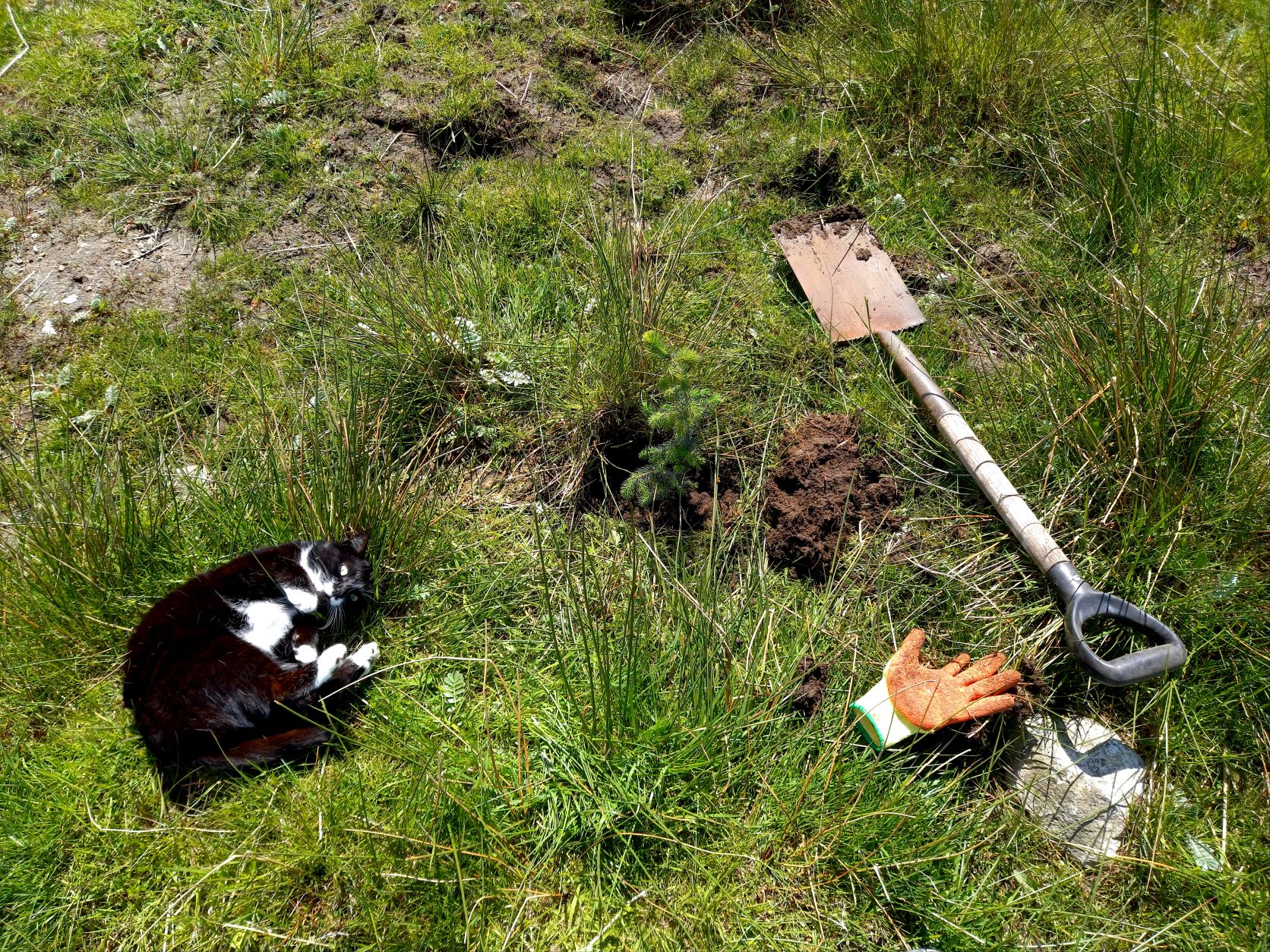
My second host was Joanna, on Great Bernera, an island connected by a small bridge to the larger landmass of Lewis. Her croft was very different because where Allie kept large flocks and ran his land like a small enterprise, Joanna had twelve Hebridean sheep which are a smaller, browner and considerably tamer breed. She ran her place with the idea of a slow project of restoration in mind. She fed the sheep by hand which is why her sheep would walk towards a person rather than away.I spent days planting trees to provide a natural barrier against the omnipresent wind. For this, I dug through stony soil to set saplings under sheets of black plastic that would warm the ground and stunt the growth of the competing grass. I rebuilt fences, dismantled old ones and rolled wire into coils. My favourite task by far was washing the freshly sheared wool in a small caravan bathtub and for the first four washes, the water would be running brown immediately. Then, slowly, the wool came out and was surprisingly oily under my hands, full of the natural lanolin that protects the wool and the sheep from dirt, cold and wetness. One afternoon Joanna took me to the community polytunnels, where she kept seedlings and a strawberry patch and we discussed how the polytunnels should be used in the next year.
Three thousand years in one afternoon
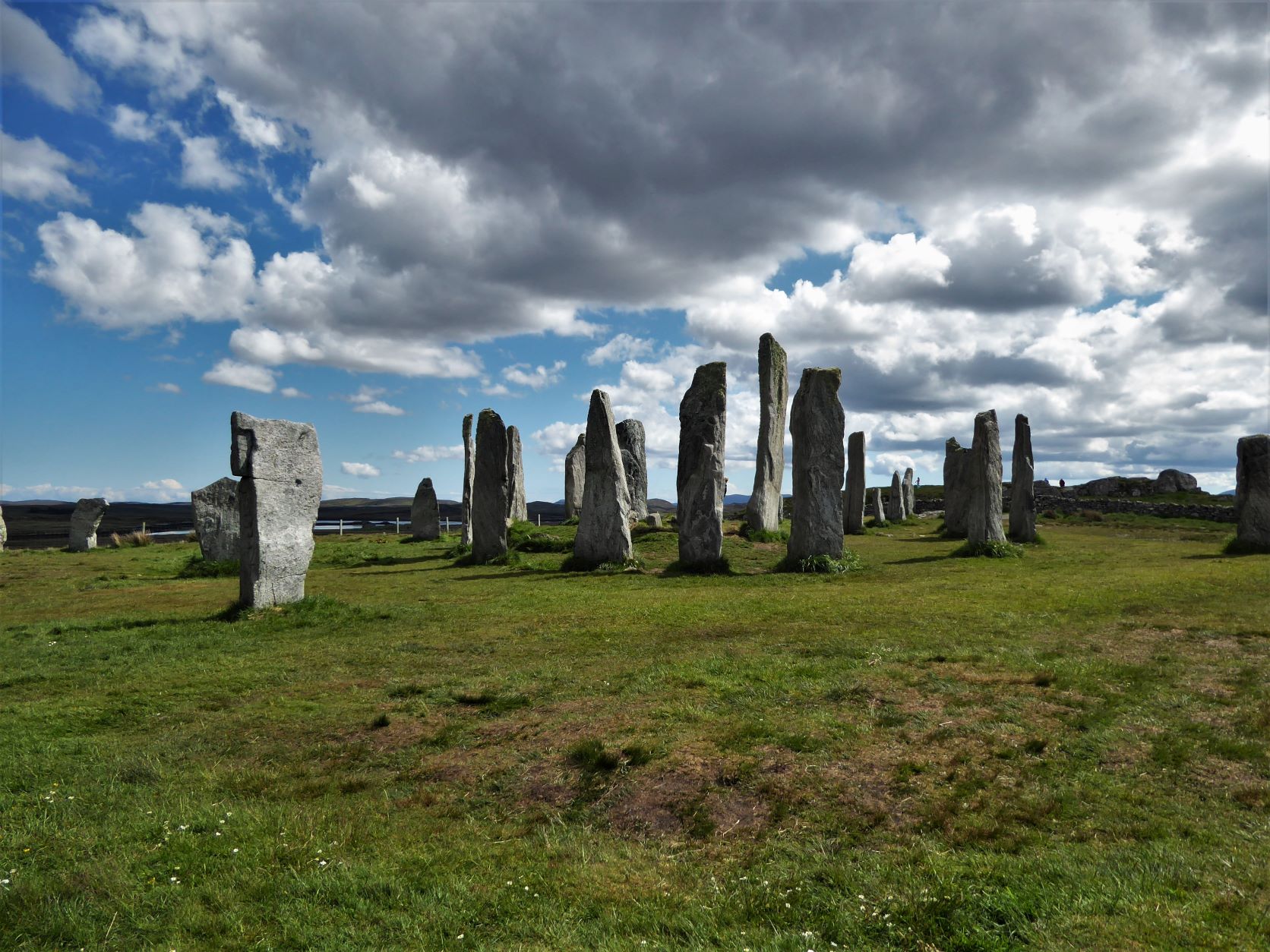
Another afternoon she drove me the length of the west coast of Lewis and explained to me the history of each stop along the way. We climbed up to a broch which is one of the round drystone towers that the people of Iron Age Scotland built nearly two thousand years ago. No one is entirely sure what brochs were for and there are theories about them beings used as defensive forts, status symbols, communal halls or some combination. They survived only in northern and western Scotland and standing inside one was very impressive. Then we went on to the Callanish stones, a stone circle older than Stonehenge by roughly two thousand years and it was raised on Lewis around 3000 BC. The tallest stone is nearly five metres high and the purpose of the site remains debated. Popular theories include an astronomical observatory, ceremonial gathering place or some weaving of the two.
Joanna explained that the smaller stone circles along the coast are all called Callanish with a number after them such as Callanish II, III because archaeologists suspect they belong to a single ritual landscape and not a series of separate monuments. We stopped at the Blackhouse Village, the preserved settlement of taighean dubha (black houses) where Hebrideans lived until well into the twentieth century. They have thick double-walled stone, thatched roofs, no chimney with the smoke from the central fire seeping through the thatch and giving the houses their name and their fertile soot which farmers later spread on the fields. The last family left their black house in the 1970s.
The language underneath
I had the impression that on Lewis, Scottish Gaelic is still spoken by the community and you clearly see it even before you hear it. On every road sign and every village name, the place is often often given in Gaelic above the English. I learned that Alba stands for Scotland, Steòrnabhagh for Stornoway and even the English names from places such as the famous Loch Ness comes from the Gaelic word Loch for lake. The language sound fascinated me since it sounds nothing like English. It is a lot softer, more sung and with consonants that do not quite exist in the languages I knew. I also realised that the sound, intonation and even sometimes structure of Scottish English was heavily influenced by the intonation of Gaelic which, as a linguist, I saw as a prime example of language transfer. It was also a very vivid reminder that the British Isles contain several languages older than the one I had come to speak.
What I took home
What I took home from those six weeks were not the things I expected. Not just the calluses or the working vocabulary but the way the work changed my attention. When you spend a whole afternoon planting trees through stony ground, you start noticing soil. When the bus driver waits for you because he was worried about you and the shopkeeper trusts a wooden box with the money, you start noticing the texture of a small economy that is held together by the assumption that everyone trusts everyone else. The two crofts were very different and yet what they had in common was a quiet attentiveness and respect for animals, the weather, the next person at the gate and for languages older than the road signs they share space with. I came home with a slightly different sense of how a place becomes itself. Some of the words I learned have stayed with me, some have already drifted. But the way of looking, I am trying to keep.