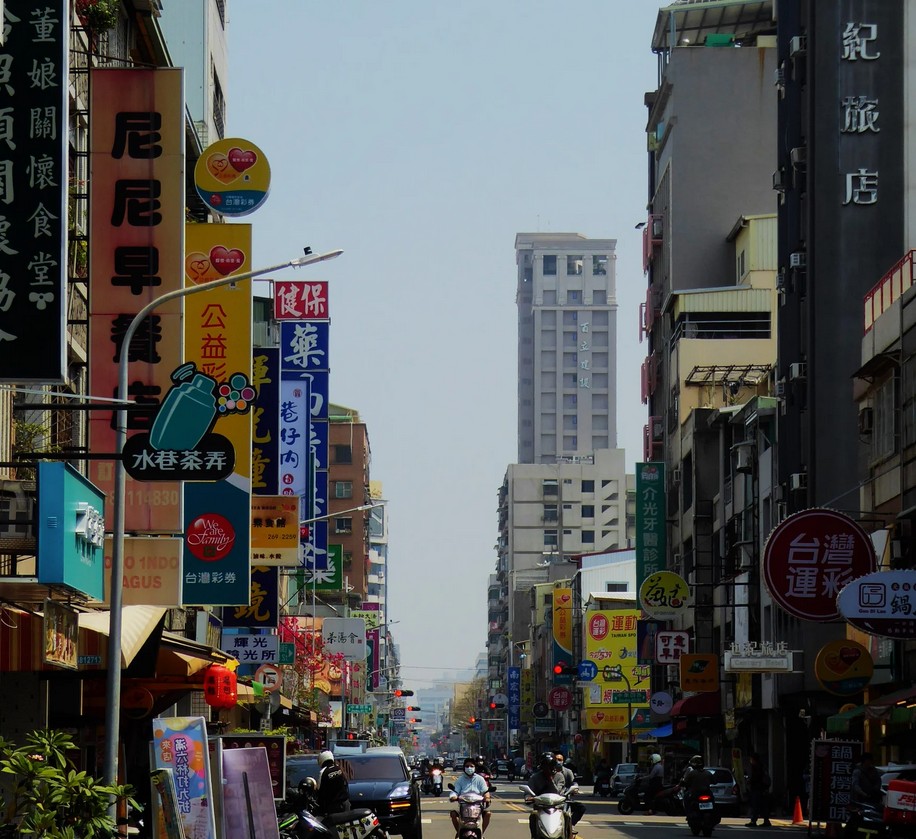
I spent four weeks crossing Taiwan from Kaohsiung in the south up to Taipei in the north and along the east and west coast with detours to islands, several mountain villages and far too many tea shops (if there is such a thing).
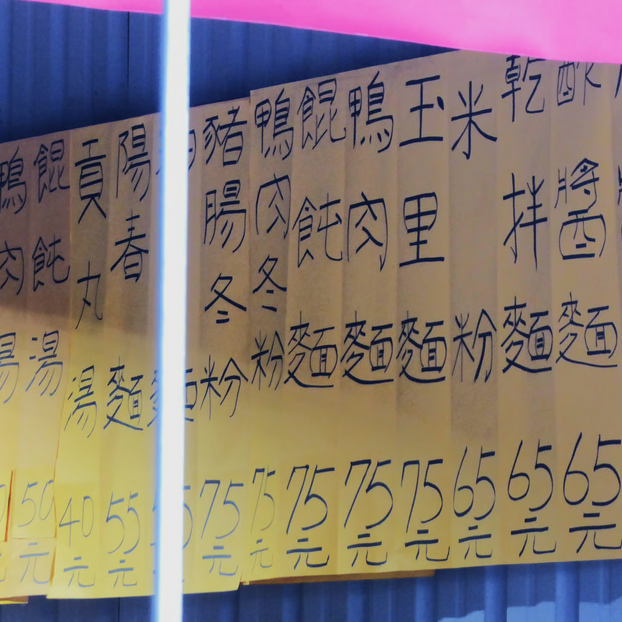
It is a fascinating experience when you realise that you have been pointing at random sequences of characters on a handwritten menu for four weeks now and against all odds, have eaten reasonably well the entire time. For a foreigner that speaks only the most basic Mandarin, travelling in Taiwan is a constant experience of figuring things out along the way. Sometimes you do and sometimes you end up with fish powder in your breakfast wrap at six in the morning.
A linguist’s paradise
The first thing you notice on a Taiwanese train is that the announcements happen four times. Mandarin first, then Taiwanese Hokkien, then Hakka, then English and that at every station. By the third stop, I tried to really listen to it to pick up the difference between those languages. What I realised the quickest was the substantial length difference for the same announcements with the English one usually being the longest.In the regions where the indigenous peoples of Taiwan still live, a fifth language gets added to all this. There are around sixteen recognised indigenous languages on the island, most of them descendants of the Austronesian family which is the same family that includes Indonesian, Tagalog, Malagasy, and Māori. Taiwan is widely thought to be the original home of Austronesian, the point from which the language family spread across the Pacific and Indian Oceans over thousands of years. Standing at a small train station on the east coast, hearing an announcement in a language related to one spoken in Madagascar, is a very beautiful experience.
Of those sixteen languages, around ten are already extinct and several more are spoken only by a handful of elders. The rest are under pressure from Mandarin, which became the official language in the mid-twentieth century and has since absorbed enormous amounts of daily life. The signage at small stations often still carries the local Indigenous name, in Latin letters, beside the Chinese characters.
What makes reading Taiwan so disorientating, at least at first, is that the script is Traditional Chinese but the older, more elaborate version of the writing system. It is kept alive on the island while the mainland switched to the simplified version in the twentieth century. A street sign in Taipei has more strokes per character than the same word would have in Beijing. Somehow, the handwritten menus, like the kind you see at every roadside stall, were artful to me, an outsider that could not read the menu. An older women explained to me while I was drinking her soup that every owner has their own brushwork and their own shorthand which they are very proud of. For me, pointing at a sequence of characters to choose my meal of the day became, after a while, a kind of aesthetic gamble. Sometimes the pretty calligraphy of a certain dish was the only reason why I chose it. After my four weeks there, I was very happy to be able to at least decipher the characters for rice , noodles and some vegetables.
I knew, when I planned this trip to Taiwan, that I was going to be looking for tea. Ever since my trip to China, I have been thinking about the tea culture that I experienced there and I was very excited to see if Taiwan could compare to this.
Taiwan’s Tea
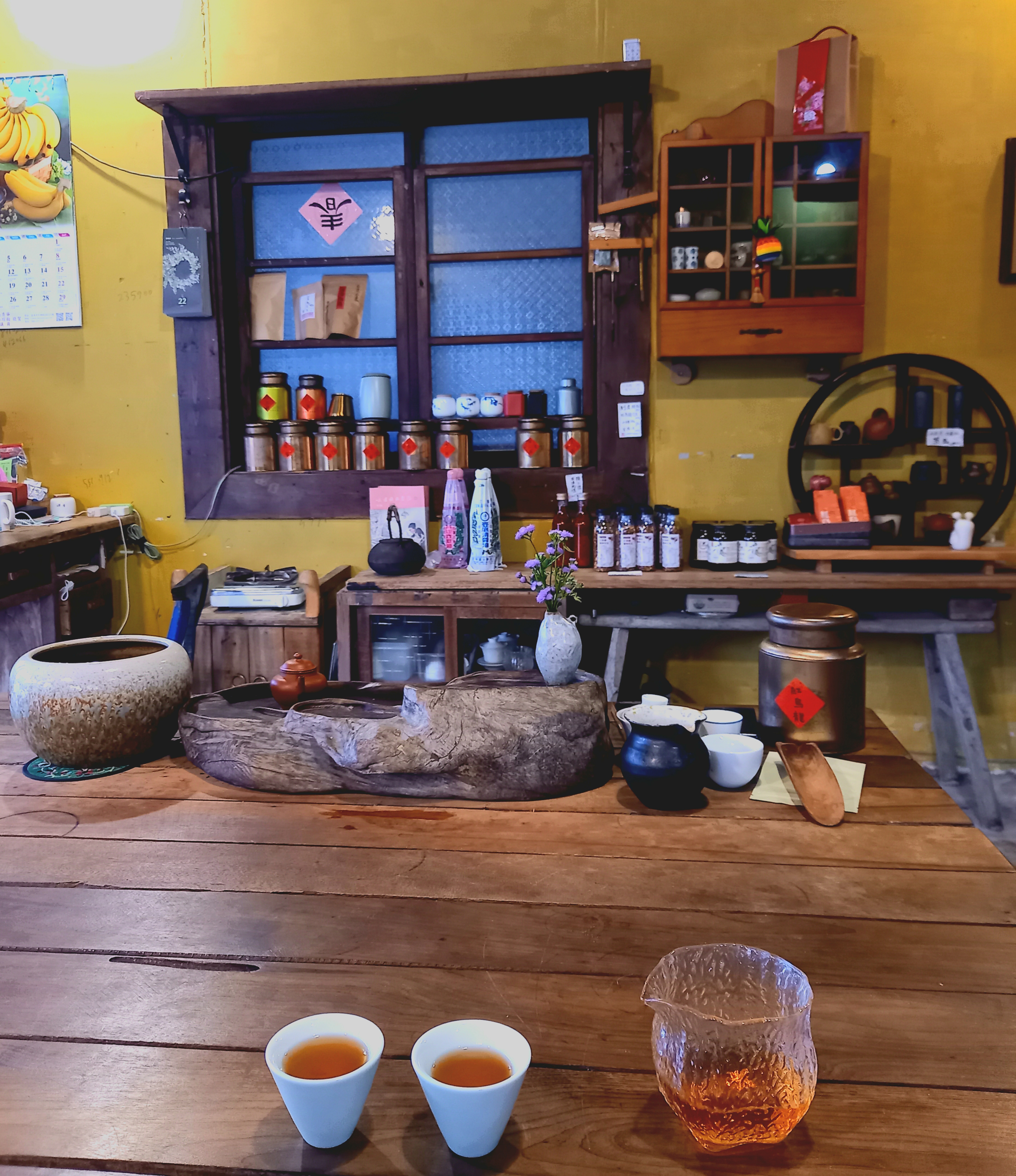
Taiwan grows some of the most distinctive teas in the world and of course I wanted to try them all. Lugu is a small town in the central mountains of Taiwan and it is surrounded almost entirely by tea fields. The roads are narrow, the shops are open only a few hours each day and nobody is in a hurry. I stayed there for four days specifically to drink tea and on the second afternoon I walked into a small shop where the owner was tending a row of bonsai trees on the pavement. He looked up, saw me hesitating and asked the only question that I understood: ”茶?” (Chá?).
He called his son, who spoke some English and the three of us had a long conversation across a table of thimble-sized cups while two kettles rotated through different temperatures. He brewed me a high-mountain Oolong which has to be grown above 2000 metres to qualify as such. The first infusion was bright and tasted faintly grassy, the second was softer, rounder and the third tasted almost sweet.
Oolong is defined by its degree of oxidation which is somewhere between green tea (almost none) and black tea (essentially complete). Within that range, every percentage point changes the flavour. A lightly oxidised Oolong tastes floral, almost like a green tea with more body. A heavily oxidised Oolong tastes warm and roasted, edging towards a black tea but never quite getting there. This means that the same plant, the same field and the same picker just with a different number of hours spent for the cell walls of the leaf to break down in air and you have produced something else.
There is the famous high-mountain Oolongs grows above 2000 metres where the cloud cover slows the leaves down, Oriental Beauty that has a honeyed flavour that comes from leafhoppers piercing the buds and triggering the plant's defence chemistry, the red Oolong invented in Luye in 2008 and the Pouchong from the misty hills of Pinglin. Each region has its own micro-tradition and its own preferred fermentation curve as well as its own arguments about which water temperature ruins everything.
What Lugu and Luye (of course I had to try the famous Red Oolong) gave me was an extensive vocabulary when it comes to tea. I now know what I am tasting for. I know the difference between a thirty-percent oxidation and a sixty. I know that high-mountain matters because the cold slows the leaf down and concentrates the oils. I brought home bags over bags of different teas and a traditional clay pot for brewing them. The pot is now on a shelf in my kitchen and in daily use. The tea, unfortunately, is mostly gone.
Pinglin and it’s tea museum
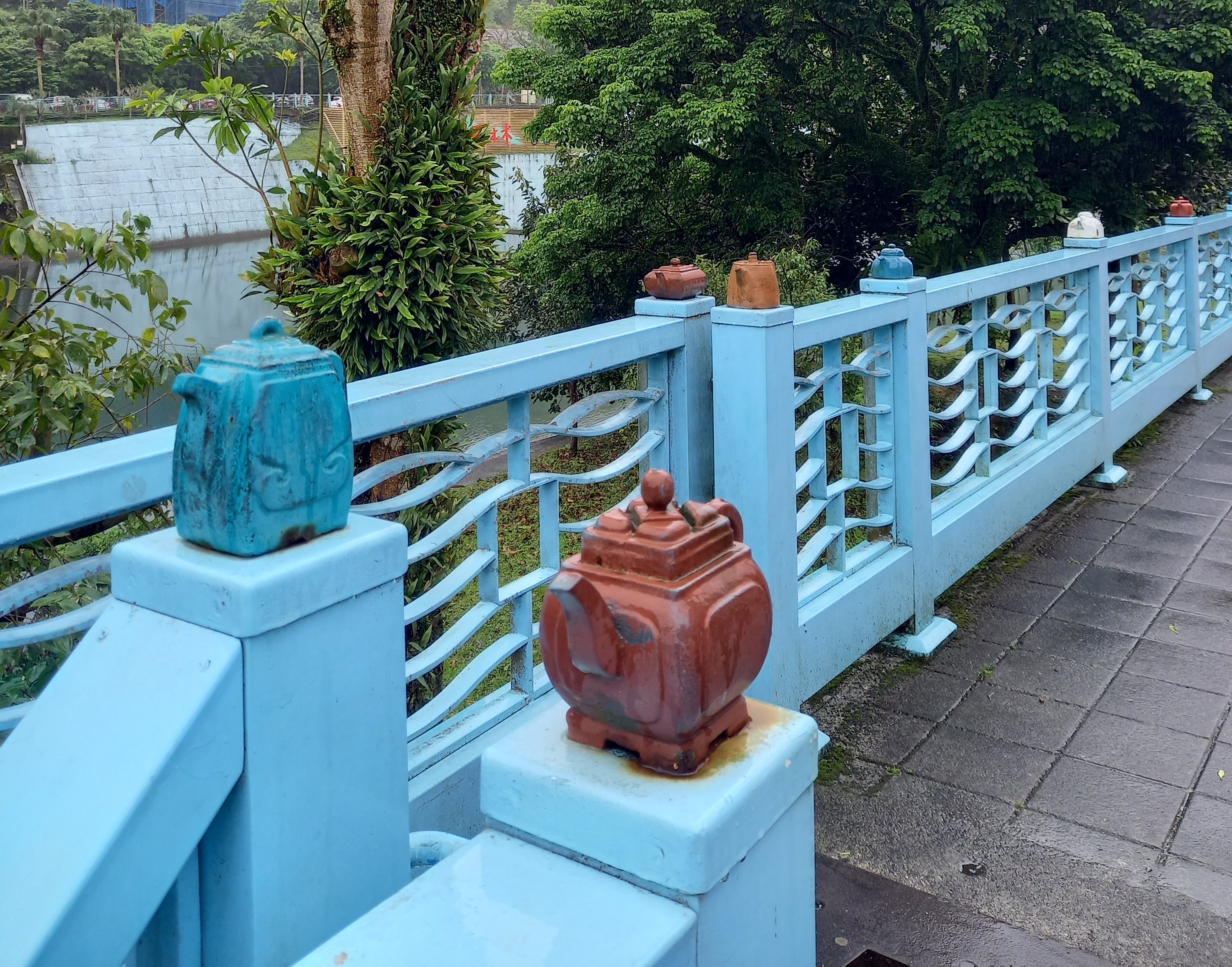
Later in the trip, I spent an afternoon at the Pinglin Tea Museum, which is among the largest tea museums in the world which to me is a slightly silly distinction, given how few there are, but the museum itself is very detailed.The exhibition walks you through the history of tea-drinking in China, which spread across the country only during the Tang dynasty (618–907 CE). Before that, tea was a southern habit, confined to the regions below the Yangtze where the plant grew. With the Tang dynasty came the first formal tea banquets at court, where rare and expensive teas were served in elaborate ceremonies. The Qing emperor Qianlong, several centuries later, took this several steps further and wrote hundreds of poems about tea, passed laws about the manufacture of teaware, hosted over forty tea banquets and had fresh water and snow imported daily so that his tea could be brewed in the proper medium.
What I found most interesting when I was walking through the exhibition, was how much of the tradition is written. There are poems about how to brew. There are treatises on water temperature and there are rankings of tea-growing regions that read like critical reviews. The museum had a long display case of historical teaware with calligraphy inscribed directly onto the pots, short verses often written by the maker.
This was, I realised at some point, why the small Taiwanese tea shops felt the way they did. The owners who brewed for me in Lugu, Luye or Alishan were performing a tradition that has been written down, argued about and refined over more than a thousand years. The thimble-sized cups, the timed steeps, the specific shape of the clay pot, the gesture of pouring the first infusion that is thrown away to wake the leaves… all of this is documented, debated and inherited.
From tea to fireworks
From the tea regions, I went to Green Island, a small volcanic island off the east coast, and on my first night there, I experienced a temple festival night. I had spent the day exploring the island and as I walked back to my hostel I started hearing a deep rhythmic banging of drums, gongs and the sound of small explosions. I followed the sound around a corner and found a procession of three small portable temples, each carried on poles by four to eight men, being walked through the village in a particular swaying step that made the whole shrine rock back and forth. One of them was strung with neon lights and was blasting techno from speakers on its roof. Another was draped in red and silver paper streamers. The third was being shaken vigorously in front of every house, while bystanders bowed and incense was exchanged between the temple-bearers and a woman waiting at each doorstep.
I wanted a closer look at the ritual, so I edged toward the smallest temple just as the man carrying the front pole touched a lit incense stick to one of the red and silver streamers. The streamers were not, as I had assumed, decorative. They were strings of firecrackers. What followed was approximately two minutes of being deafened, blinded and partially showered with burning paper while wedged between two house walls with no obvious exit. I am not sure I have ever stood that still in my life.
The procession moved on. I joined the crowd at a (this time) more responsible distance and watched the rest of the ceremony, which built slowly towards a final scene at the village's main temple. Each temple was carried into a wall of detonating firecrackers so dense that for a few seconds the bearers and the shrine were entirely invisible inside a ball of smoke and light. Then the temple came back out again, was lifted over the threshold of the main building and disappeared inside while people were applauding. The bearers came out afterwards and were handed beer at a parked car. One had a burn on his wrist, another on his foot. Their clothes were full of small black holes.
I have learnt since that the noise and the red colour are meant to drive away evil spirits which is the same logic that explains why every door in Taiwan, throughout the whole year, is hung with red paper posters bearing auspicious characters. The posters are put up at Lunar New Year and stay up indefinitely. Some are very glittery, some are painted with calligraphy of flowers or zodiac animals and others are simply blocks of red with the character for fortune in gold. They are written charms.
Temple doors, gods and answers
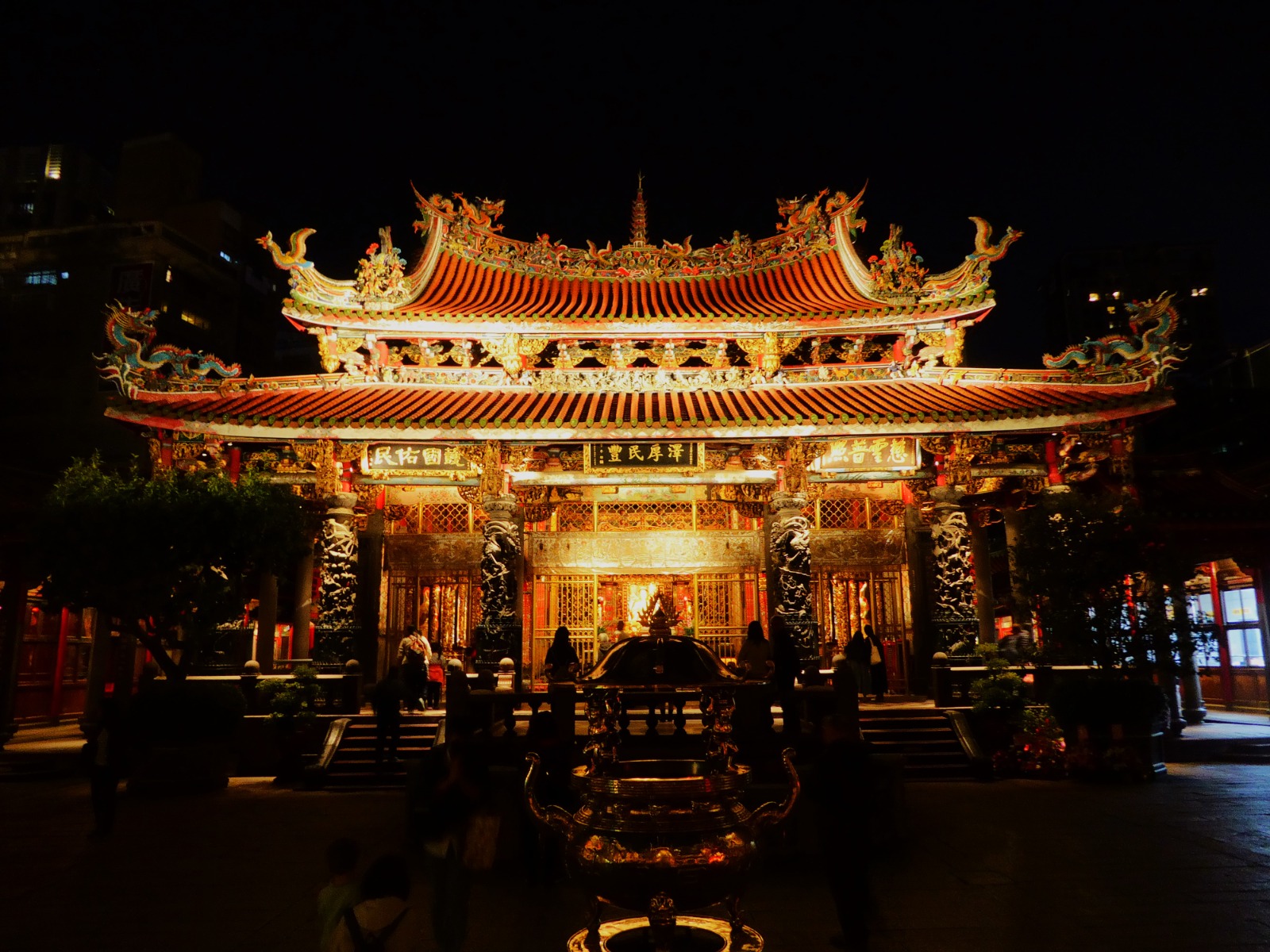
The Longshan Temple in Taipei, the oldest in the city, is dedicated to a blend of Buddhism, Taoism and Confucianism. A Taiwanese friend showed me around and explained that a temple is a kind of map and once you know how to read it, the architecture tells you who is inside, what they do and how to address them.
You enter through the right-hand door, which represents the dragon (lucky, you walk into its mouth willingly). You leave through the left-hand door, which represents the tiger (less lucky, you would rather not walk into its mouth at all). The roof above the central deity is constructed without nails and instead is a structural tradition that interlocks the wooden beams into a self-supporting octagon. The octagon represents the Eightfold Path. Every architectural detail is doing two things at once, it is holding up the building while also meaning something.
In the back of the temple stand the more specific gods such as gods for firefighters, students, medicine and the dead. Each has a particular day on which they are most active and most petitioned. The student god is very busy during exam season and students leave their student ID cards on the altar the night before a test, so the god can bless them before they are carried into the exam hall. The relationship god has, in recent years, started receiving concert seating charts, with the believer's preferred seat marked in pen. People also leave wedding seating plans, with notes about which difficult relative should not be placed near which other difficult relative. I saw a concert seating chart in person. The hopeful seat was circled in red.
The system also accommodates questions. Beside each altar there is a box of crescent-shaped wooden blocks and you hold your yes-or-no question in your mind and drop two of them on the floor. Depending on which sides land up, you get yes, no or uncertain. If the answer is uncertain, you draw a numbered stick from a separate container, take that number to a wooden cabinet of small drawers and find inside a slip of paper with a short poem. The poem is divided into categories such as money, romance, health, study and the relevant category contains your answer, just in metaphor.
What I take with me
On my last day in Taipei, I climbed Elephant Mountain to watch the sunset over Taipei 101, which is so much taller than every other building in the city. I had walked across most of the city to get there and I had passed, on that day alone, a memorial to victims of the White Terror, an entire street where every single shop sold only chairs, a bank district full of tiny temples between glass towers and a small park where teenagers were being made to jog in the hot midday sun by a teacher. Taipei is a city where eras stack on top of each other.
What stayed with me the most is how accommodating Taiwanese are. If they realise that you are struggling to find the right bus stop, they will stop their scooters in the middle of the road to escort you to the right bus stop. If you struggle in choosing which bubble tea flavour to choose today, all the customers around you will give you their personal suggestions. As a tourist, you can just go to the country, assume you can manage and thanks to the Taiwanese you most definitely can.