I went to Georgia for three weeks with a tent and absolutely no knowledge of the local language. As always, my plan was to let the country surprise me and while I had places in mind that I wanted to see, I was open to see where the journey would take me. I hoped for campsites all over the country and a working bus network.
Georgia is famous for their mountain roads and I got my first impression of them when I was picked up by a Georgian truck driver who did not speak any English. He was extremely cheerful, drove with one hand on the wheel and the other on his phone and was taking curves next to deep precipices with a speed and confidence of someone who had been doing this for thirty years. I spent most of the drive trying very hard to enjoy the views and not being scared.
A note about Georgian language
Georgian is not an Indo-European language. It is part of the Kartvelian family, a small group of four related languages spoken almost exclusively within the borders of Georgia. It has its own alphabet, called Mkhedruli, with thirty-three letters that do not resemble Latin, Cyrillic, Greek, Arabic or any other script you might already half-recognise. Everything is written in a beautiful curling script and after a week I could pick out the letter that resembles a small spiral and the letter that looks like a curved hook. After two weeks I could decipher some of the food items on a menu.The phonology is famously difficult. Georgian has a class of consonants called ejectives which are sounds made by closing the throat and releasing air with a small popping click and that I had never personally encountered. There are consonant clusters that look unpronounceable on the page and (for me) turned out to also be unpronounceable in the mouth. What surprised me was that even though I spoke no Georgian, a suprising amount of information could still be transferred to me just through gestures. I had conversations over kitchen tables across three weeks happened that almost entirely without spoken language just by smiling, nodding and miming actions such as eating.
A backyard in Mestia
What I very quickly learned is that in Georgia, if you step out of a bus or car in a small town and start asking around for a campsite with a small drawn sign of a tent, people will never lead you to the campsite. Instead, they always offered me their backyard. I first learned this in Mestia, the small town in the Svaneti region that serves as the gateway to the High Caucasus. I knew there was a campsite in that town, so I assumed I would eventually find it since the town is basically one long street.
The second woman that I asked for directions after I had wandered the whole city and could not find the campsite, waved me into her garden, gestured at a flat patch of grass between her vineyard and her apple trees and made a tent shape with her hands. I set up my tent and she brought me a thermos of tea. In the morning, I woke up to her children quietly (as quiet as children can be) inspecting my tent from the outside and a cow slowly grazing grass next to my tent
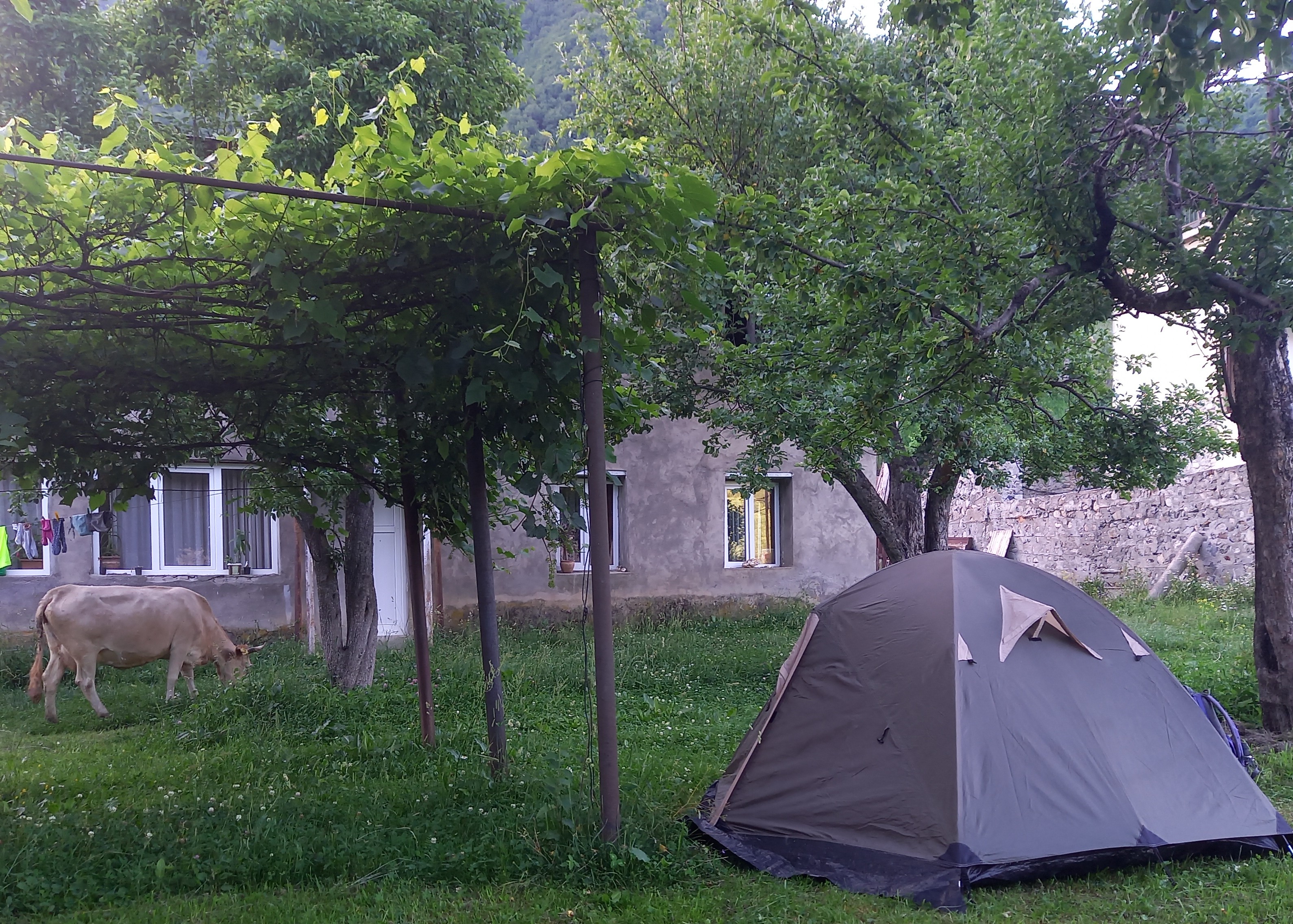
When I tried to take my tent down to find the campsite that I had heard of, the woman ran towards me and gesticulated wildly to let me know that I can leave it there as long as I want to. So, I spent the day wandering through the little town and the surrounding mountains while constantly taking off or putting on my jacket since the sun was very strong but there was still an icy wind blowing from the mountains. When I came back, the family apparently had some kind of celebration going on because I came back to the backyard full of people sitting at a long wooden table in the yard. A cow (hopefully not the on, I just saw in the morning) had been butchered earlier that day and various parts of it were now on the table in various stages of preparation.
There was khinkali (Georgian dumplings) that you eat by holding the twisted top and biting into the side and drinking the broth out before it escapes. There was a platter of grilled meat that I could not identify and masses of bread, cheese and tomatoes as well as a clay jug of homemade wine. Later on, I learned that the wine in Georgia is prepared with the so-called Qvevri Method during which the grapes are placed in large clay jars that are then buried in the ground for fermentation and maturation. This method results in amber-coloured wines that taste very fruity.
On top of the celebration, a football game was showed in the TV in the living room since apparently it was the first time that Georgia qualified for the European Championship. I ate for about three hours. Every ten minutes, a new toast was made and I have never been so full in my life. At the end of the dinner, when it was time for desserts I brought out (my unfortunately small amount) of German sweets that I brought as a snack during my travels and they were tried by everyone.
The rest of my days in Mestia, my tent stayed in their backyard while I explored the surroundings. When it was time to leave, the children gave me a selfmade bracelet and accompanied me to the bus stop.
Even more Georgian food
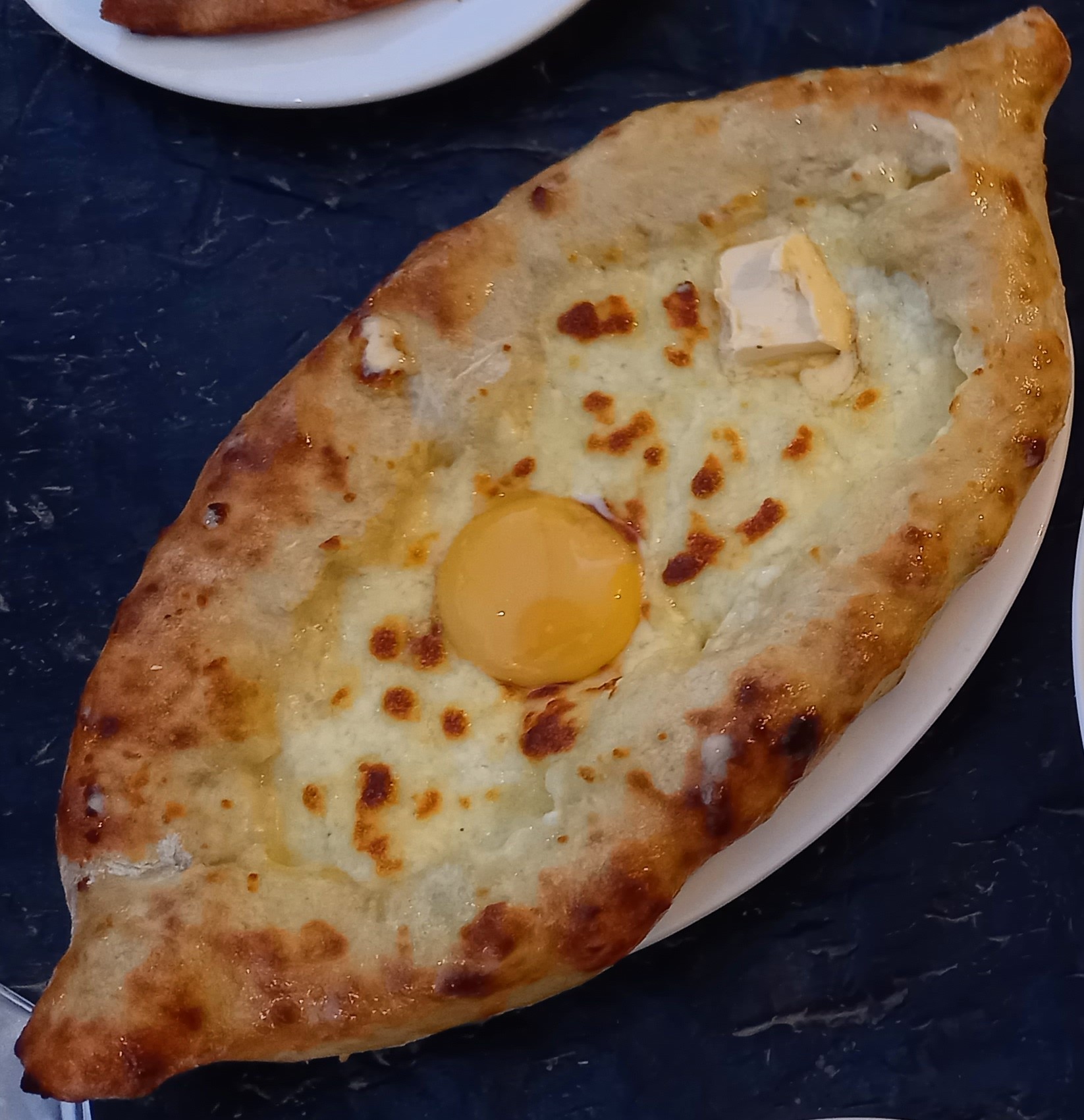
My favourite single dish was nigvziani badrijani which translates to eggplant with walnuts. It is thin slices of eggplant, fried until soft and then rolled around a paste of ground walnuts mixed with garlic, coriander, fenugreek, vinegar and pomegranate seeds and then served cold. The first time I ate it was in Mestia and since I liked it so much, I tried to ask her how she made it. She brought out the walnuts and the eggplant and the spice jars and demonstrated the entire recipe, while I nodded and tried to remember the proportions in the hopes to recreate it.The other dish I cannot stop thinking about is khachapuri which means cheese bread. During my time in Georgia, I discovered at least four regional varieties. Some of them are flat and round, others shaped like a boat with cheese all over it and another one had a lake of cheese in the middle that was topped with a raw cracked egg that slowly cooks. Almost every dinner that I ate was served to me by someone in whose backyard I stayed and money was never accepted for it.
Ushguli and the mountain I never saw
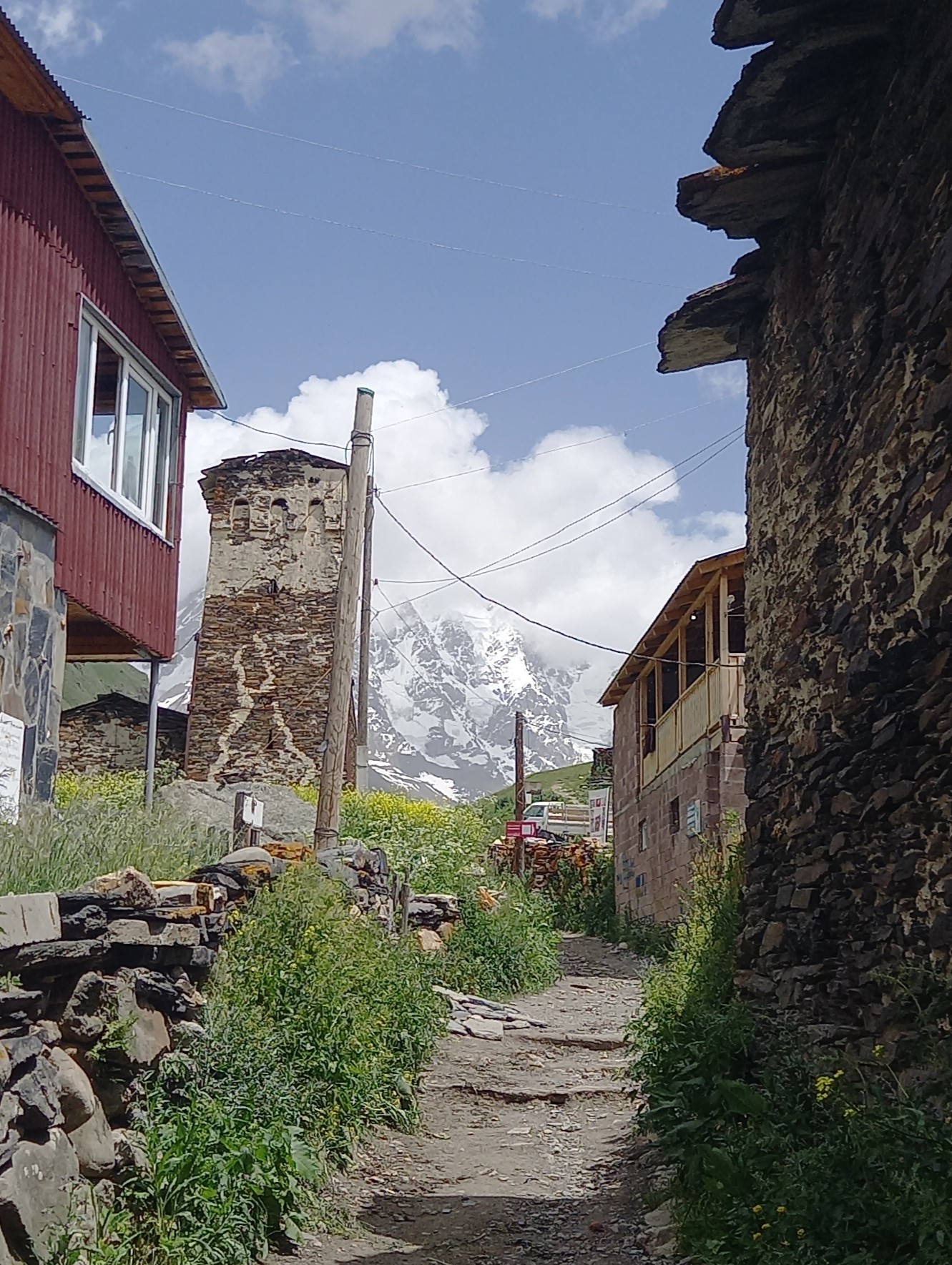
Ushguli is a village in the Svaneti region of the Caucasus, at an altitude of roughly 2200 metres and is said to be one of the highest continuously inhabited settlements in Europe. It is also one of the most photographed villages in Georgia, primarily because of its medieval stone defensive towers which are slim four-storey watchtowers built between the eighth and twelfth centuries to defend against raiders, blood feuds and avalanches.
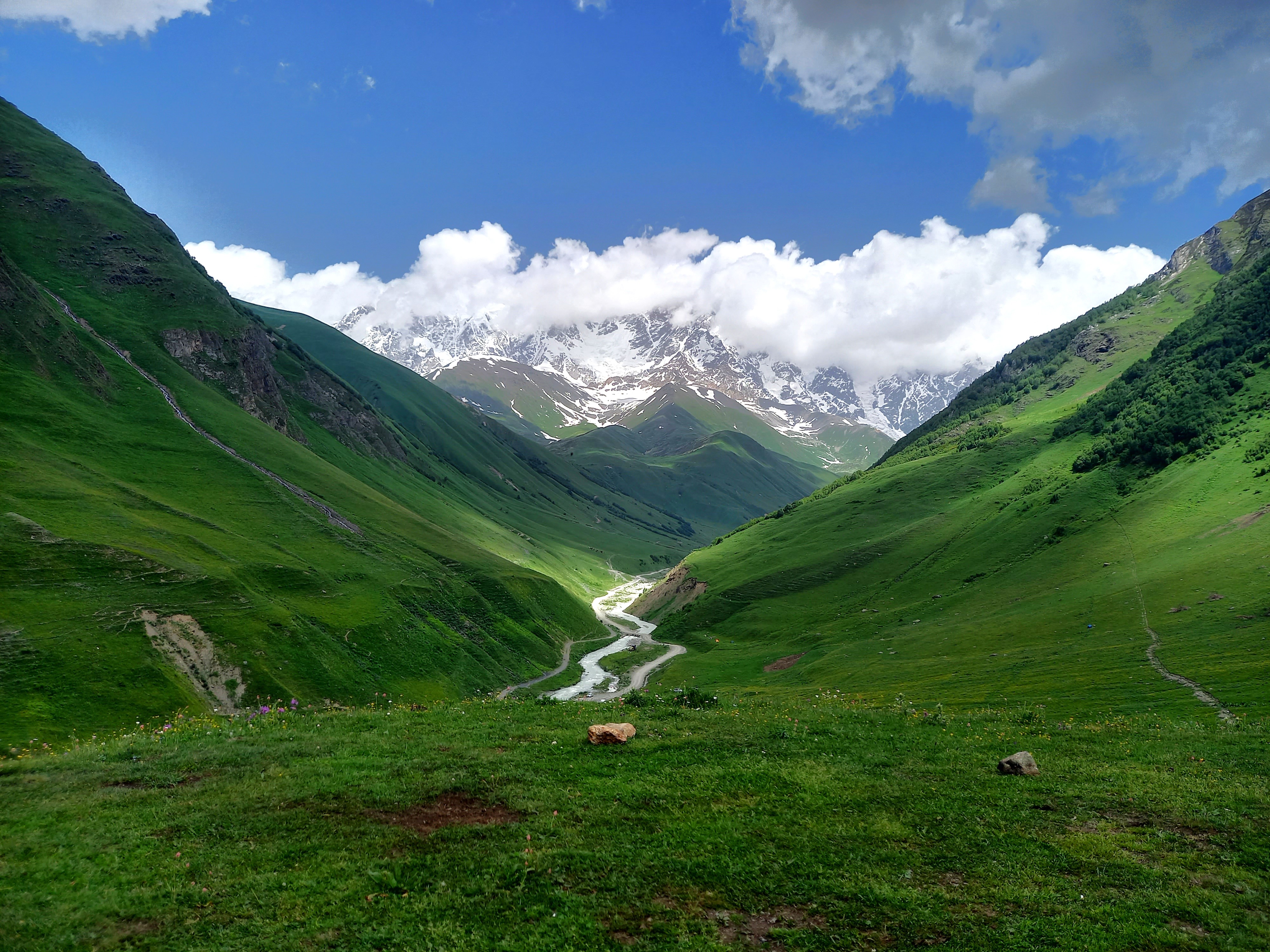
I spent four days in Ushguli and every morning woke up to the of the towers and the mountain. The mountain is called Shkhara and is the third-highest peak in Georgia and one of the highest in the whole Caucasus range but I never saw it fully. The cloud cover was completely obscuring the top, the entire time I was there.
On my first day there, my host of the night gestured at me and made a riding motion to me. Since I have been on the back of a horse only a few times in my life, I shook my head and smiled at him and he left. One hour later, he was back with two horses and pointed at one of them, then at me. We rode (very slowly, thanks to my inexperience) for about three hours, along the dry bed of a river that, in spring, must have been flooded. What he was showing me was the way Georgians used to travel through these valleys before there were roads. The path he took followed the river bed because the river bed was the only natural flat ground in a landscape that was otherwise mountainous.
Ushguli at night, after the day tourists had taken their cars back down the mountain to Mestia, was the quietest place I had ever been. There were no streetlights and no traffic. The villages two hundred and fifty residents went to bed very early and enjoyed sitting outside my tent and listening to the sound of the wind moving through the towers.